The Norwegian Method Applied: Why Precision Over Time May Be the Missing Key to Running Faster and Staying Healthy
How Marius Bakken’s “Precision Over Time” philosophy confirms what I’ve learned over 40 years as a runner, physical therapist, and healer.

This article is my personal interpretation of ideas presented by Marius Bakken, MD, in The Norwegian Method Applied. Any errors in interpretation are my own. I highly recommend reading the original book for the full framework and detailed explanations.
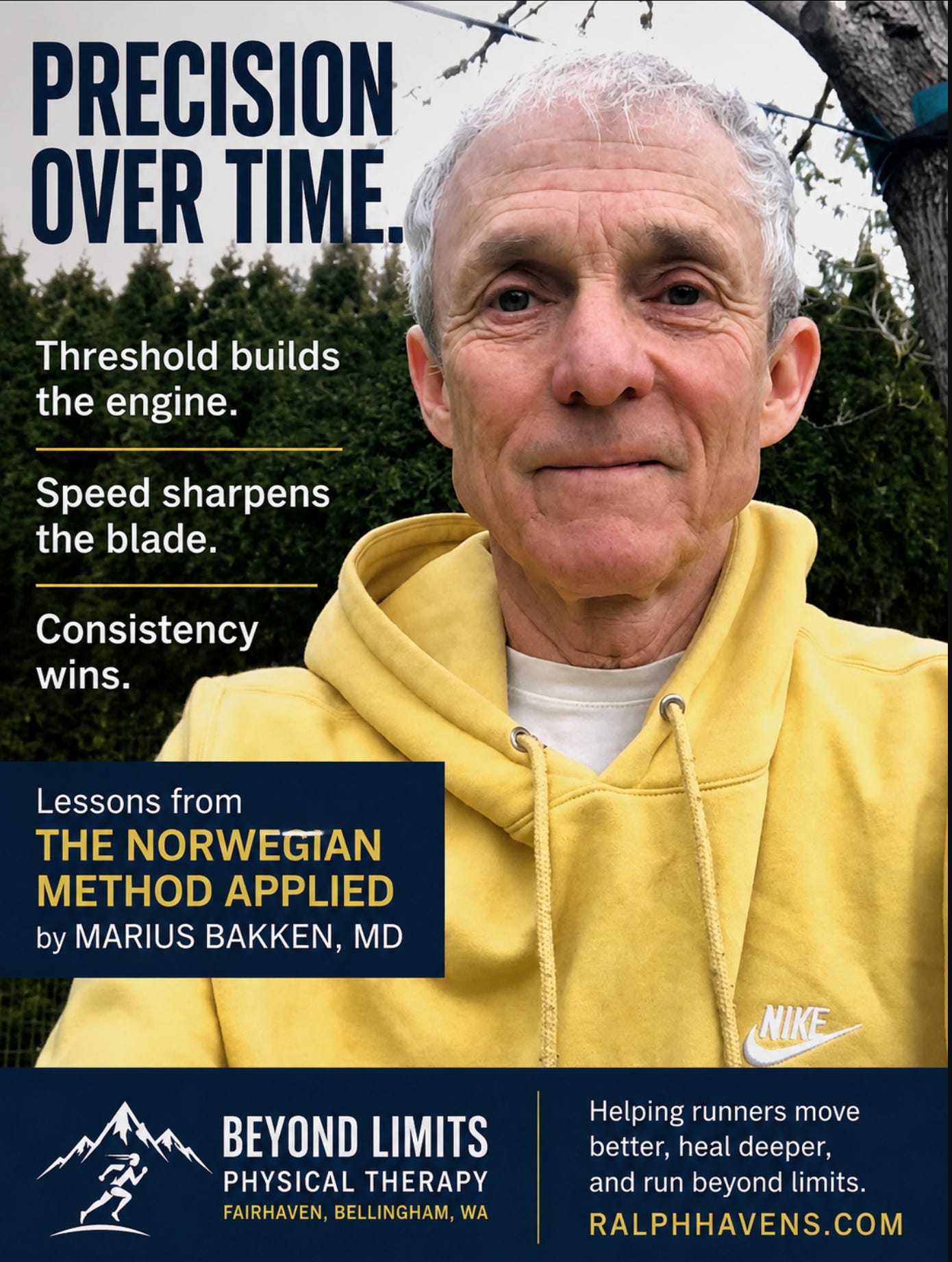
The Norwegian Method Applied: Why Precision Over Time May Be the Missing Key to Running Faster and Staying Healthy
Threshold builds the engine. Speed sharpens the blade. Consistency wins.
How Marius Bakken’s new book is changing the way I think about running, healing, and what really leads to world-class performance.
Introduction: The Question That Has Guided My Life as a Runner and Physical Therapist
For most of my life, I’ve been fascinated by one question:
What really helps runners get faster, stay healthy, and keep improving year after year?
As a lifelong runner, former Texas A&M track/cross country athlete, physical therapist for more than 40 years, and practitioner of Integrative Manual Therapy for over 25 years, I’ve spent decades studying biomechanics, injury recovery, and the deeper healing processes that allow people to perform at their highest level.
I’ve seen the same pattern over and over.
Some runners train incredibly hard but break down.
Others seem to improve steadily for years.
They stay healthy. They recover predictably. Their performances continue to climb.
What makes the difference?
I believe one of the clearest answers I’ve ever encountered comes from Olympian and coach Marius Bakken, MD in his extraordinary new book, The Norwegian Method Applied.
Marius Bakken, MD, ran 13:06 for 5,000 meters and represented Norway in the Olympics. Through years of self-experimentation and thousands of blood lactate tests, he developed a precise approach to threshold training that helped shape the training philosophy now associated with athletes like Jakob Ingebrigtsen, Kristian Blummenfelt, and Gustav Iden.
You can learn more and get the book at the Norwegian Method applied link.
If I had to summarize the entire book in one phrase, it would be this:
Precision over time.
Not one heroic workout.
Not one breakthrough session.
But week after week of training at exactly the right intensity, so you can keep moving forward.
That is where extraordinary fitness is built.
The Big Idea: You Don’t Improve by Training as Hard as Possible
One of the most powerful ideas in the book is this:
You do not improve by training as hard as possible. You improve by training hard enough, often enough, for long enough.
This is the practical heart of the Norwegian Method.
The goal is not to impress yourself in today’s workout.
The goal is to create a training pattern that can be repeated consistently for months and years.
Because fitness does not come from a single workout.
Fitness comes from a pattern that repeats.
The Golden Zone: The Sweet Spot of Sub-Threshold Training
At the center of the Norwegian Method is what Marius Bakken calls the Golden Zone.
This is the intensity just below anaerobic threshold.
It is hard enough to stimulate profound aerobic adaptations, but controlled enough that you can recover predictably and repeat the work.
For many runners, this corresponds to approximately 2–4 mmol/L of blood lactate, although the exact number is highly individual.
The point is not a universal number.
The point is to find your highest sustainable training intensity.
This is where adaptation happens.
At this intensity, you maximize:
Mitochondrial development
Capillary density
Lactate clearance
Aerobic power
Running economy
Durability
While minimizing:
Excessive muscle damage
Unpredictable recovery
Injury risk
Overtraining
This is threshold training in its purest form.
Precision Over Time
One of Marius Bakken’s most important insights is that training is fundamentally about managing load over time.
Threshold-adjacent work is performed at an internal intensity high enough to drive adaptation, yet subtle enough to be repeated with quality.
The goal is not individual sessions that impress.
The goal is weeks that hold together.
When execution is precise, you can accumulate substantial relevant work without creating a recovery cost that gradually erodes continuity.
That phrase—weeks that hold together—may be one of the most important concepts in endurance training.
Why Small Errors Become Big Problems
For experienced runners, small deviations can have enormous consequences.
A threshold session that is slightly too hard.
An easy run that drifts slightly too fast.
A new pair of shoes.
Too much strength work.
These small changes may not cause obvious problems immediately.
But repeated over weeks, they accumulate.
This is how continuity becomes fragile—even for runners who appear to be doing everything right.
Precision Does Not Mean Identical Numbers
This is a crucial distinction.
Precision does not mean hitting exactly the same pace every day.
Precision means producing the same type of internal load.
Pace is useful when conditions are stable.
Heart rate provides a safeguard.
Perceived exertion is always relevant.
Blood lactate offers the most precise feedback.
But the real question is simple:
Are you using your metrics to control the effort, or to prove your fitness?
When these signals are used as control tools rather than performance tests, training becomes far more repeatable.
Predictability: The Hidden Secret of Great Training
One of the greatest advantages of threshold training is predictable recovery.
After a well-executed threshold session, you generally know where you stand.
You know when you’ll be ready for the next quality workout.
In contrast, maximal interval sessions can produce highly variable recovery needs.
Sometimes two days.
Sometimes a week.
This unpredictability is costly.
It leads runners either to train too hard when they should recover, or to rest when they are actually ready to train.
Threshold training reduces uncertainty.
And predictability is one of the foundations of continuity.
Muscular State: The True Bottleneck
One of the most profound ideas in Bakken’s book is that the cardiovascular system often recovers faster than the muscular system.
Your heart and lungs may be ready.
But your muscles, tendons, fascia, and nervous system may still be carrying the cost of prior training.
This is where many runners get into trouble.
They feel aerobically capable, but their tissues are not prepared.
In my work with Integrative Manual Therapy, this is exactly where hidden restrictions show up.
Scar tissue.
Joint restrictions.
Fascial tensions.
Autonomic stress.
Old injuries.
These factors can become the real limiting factor in performance and durability.
Marius Bakken emphasizes the muscular state as the true bottleneck.
I believe this insight is extraordinarily important.
The Aerobic Foundation
The Norwegian Method is not simply threshold intervals.
It is built on a substantial base of easy aerobic running.
Easy mileage:
Strengthens connective tissue
Enhances fat metabolism
Improves recovery
Expands aerobic capacity
Supports higher training loads
Think of the system as a pyramid:
Easy aerobic running
Sub-threshold training
Speed and race-specific sharpening
The larger the aerobic base, the higher the performance ceiling.
Double Threshold Training
One of the most famous aspects of the Norwegian system is the double threshold day.
Advanced athletes may perform:
Threshold workout in the morning
Threshold workout in the afternoon or evening
Because intensity is precisely controlled, athletes can accumulate extraordinary amounts of quality work while keeping recovery manageable.
This approach is not necessary for most runners.
But it demonstrates the central principle:
If intensity is correct, training can be repeated.
Speed Work: The X Factor
Many people assume the Norwegian Method ignores speed.
Nothing could be further from the truth.
Speed work is essential.
But it is layered on top of a threshold foundation.
The key is that speed never interferes with the Golden Zone.
Threshold remains the center.
Everything else is built around it.
Strides
Year-round, most runners benefit from:
6–10 × 100 meters
Relaxed and fast
Full recovery
Strides help maintain:
Running economy
Coordination
Turnover
Posture
Neuromuscular sharpness
Hill Sprints
One of my favorite tools for runners.
Typical prescription:
6–10 repetitions
8–12 seconds uphill
Full walking recovery
Hill sprints improve:
Force production
Tendon stiffness
Sprint mechanics
Injury resilience
With minimal metabolic cost.
Mile Pace and Race-Specific Work
As races approach, runners can add:
200–400 meter repetitions
Mile pace intervals
3K and 5K pace work
Race simulations
These workouts sharpen the ability to express aerobic fitness at race speed.
But they remain secondary.
Threshold still does the heavy lifting.
Protect the Golden Zone
This may be the most important practical rule.
Every workout should be evaluated by one question:
Does this support my ability to continue sub-threshold training, or does it interfere with it?
If a workout creates excessive soreness, unpredictable recovery, or increased injury risk, it is too costly.
The Golden Zone must always be protected.
That is where sustainable adaptation occurs.
Conservative Periodization and Respect for Transitions
Bakken emphasizes that injuries often occur not during stable heavy training, but during transitions.
Examples include:
New shoes
New surfaces
Added strength work
Increased volume
Moving from treadmill to asphalt
Transitions require caution.
The body must adapt gradually.
This principle alone can save many runners from avoidable setbacks.
What the Method Requires
The Norwegian Method is simple.
But it is not easy.
It requires:
Discipline to hold back
Patience to trust the process
Honesty to adjust when you’ve done too much
Careful observation of muscular state
Consistency over long periods
If you use a lactate meter, you gain extraordinary precision.
If you do not, heart rate and perceived exertion can work extremely well—provided you are honest with yourself.
Start Where You Are
One of the most encouraging messages in the book is that you do not need advanced technology to begin.
You do not need a perfect program.
You simply need to:
Find your Golden Zone.
Train there regularly.
Keep easy days truly easy.
Be conservative.
Protect continuity.
Week after week.
Month after month.
Year after year.
Why This Matters So Much to Me
This philosophy resonates deeply with what I’ve observed in my own journey.
At age 37, while running 70–90 miles per week and managing a large physical therapy practice in San Diego, my body suddenly shut down with a severe calf spasm.
That experience sent me on a decades-long search to understand the true causes of injury and recovery.
I invested hundreds of thousands of dollars studying Integrative Manual Therapy, biomechanics, Matrix Energetics, and other healing methods.
What I found is that the body often has hidden restrictions that prevent athletes from fully benefiting from their training.
When those restrictions are released:
Running mechanics improve
Recovery becomes more predictable
Pain resolves
Performance often jumps dramatically
How Integrative Manual Therapy Fits In
Marius Bakken emphasizes that muscular state is the real bottleneck.
I believe Integrative Manual Therapy can play a profound role here.
By improving joint motion, fascial mobility, autonomic balance, and tissue healing, runners may be able to:
Tolerate more threshold work
Recover more predictably
Reduce injury risk
Improve stride mechanics
Unlock performance gains
The Norwegian Method provides an extraordinary physiological framework.
Integrative Manual Therapy helps optimize the structure that must carry out the work.
Together, they form a remarkably powerful system.
A Simple Weekly Template for Advanced Runners
Monday: Day Off
Tuesday: am: Threshold workout 3 to 8 minute ST repeats 60-90sec rest, pm: 10 x 1 minute at ST with 30 sec rest.
Wednesday: Easy run
Thursday: am: Threshold workout 1 mile at ST then short intervals 1 minute at ST / 30 sec rest pm: 45 ST/15 sec rest or an X Factor Speed workout with full recovery or race-specific sharpening (seasonally)
Friday: Easy or off
Saturday: Easy run
Sunday: Long run easy pace
This template can be adapted for recreational runners, competitive athletes, and elites.
A Simple Weekly Template for middle school & high school runners
Monday: Day Off
Tuesday: Threshold workout ST 3 to 8 minute repeats with 1 minute to 90 sec rest
Wednesday: Easy run
Thursday: Thursday ST would be 45/15’s or 1 min ST/30 sec rest, or
45 sec ST/15 sec rest X-Factor Speed workout with full recovery or race-specific sharpening (seasonally)
Friday: Easy or off
Saturday: Easy run
Sunday: Long run easy pace
This is only a template to get some ideas and Marius Bakken’s book has much more detail.
The Most Important Lesson
If you take one idea from Marius Bakken’s book, let it be this:
You don’t build fitness from one workout. You build fitness from a pattern that repeats.
Find your Golden Zone.
Train there consistently.
Keep easy days easy.
Protect your muscular state.
Respect transitions.
Be patient.
This is how extraordinary performance is built.
Final Thoughts
I have read many great books on running over the years.
Works by Arthur Lydiard, Jack Daniels, Renato Canova, and many others have shaped how coaches and athletes think about training.
I believe The Norwegian Method Applied deserves a place among the most important of them.
Marius Bakken has taken complex physiology and distilled it into a practical framework centered on precision, repeatability, and continuity.
It respects the body’s fundamental biology.
And perhaps most importantly, it works because it makes it possible to train tomorrow.
Work With Me
If you’re a runner dealing with recurring injuries, unexplained limitations, or a sense that your body is holding you back, I’d love to help.
At Beyond Limits Physical Therapy in Fairhaven, Bellingham, Washington, and through online sessions worldwide, I help runners uncover and resolve the hidden structural and energetic barriers that interfere with healing and performance.
The goal is simple:
To help you train consistently, move freely, and discover what is truly possible.
Learn more at https://ralphhavens.com.
With Deep Gratitude to Marius Bakken
My sincere thanks to Marius Bakken MD for his decades of experimentation, disciplined thinking, and willingness to share this work with the running community.
His book offers a gift to runners and coaches at every level.
The message is both sophisticated and wonderfully simple:
Precision over time.
And in the end, that may be the most powerful training principle of all.
With deep gratitude to Marius Bakken MD for his decades of experimentation and for sharing a training framework that may transform how runners and coaches think about performance, recovery, and durability.